








No visibility.
No control.
When coverage is patchy or unavailable, the only way to monitor and respond is to send someone out. Choose cellular and your assets can go dark. Choose legacy satellite and the costs spiral. Either way, you lose.
No business should have to accept that.
We built what was missing
The Starlink D2C network changes everything, but no one had built a complete M2M and IoT system to unlock it.
Developed under NDA with SpaceX, RIVIR spent three years building a seamless bridge between your assets and the systems you already use.
The missing piece was always the system. Now you have it.

RIVIR in your industry
The RIVIR System is adaptable for remote, mobile and critical assets across industries.
Oil and Gas
Monitoring wells, pipelines, emissions and energy infrastructure.
Automotive
Asset tracking, telemetry and over-the-air configuration.
Agriculture
Remote monitoring of agricultural environment and machinery.
Environmental
Monitoring of remote weather, emissions and water quality.
Mobile Network Operators
Partner with RIVIR to unlock the full potential of your terrestrial and satellite networks.
Tier 1 Parts Suppliers
Partner with RIVIR for improved heavy equipment and automotive connectivity.
Utilities
Smart grid automation, resilience and remote metering.
Other
Talk to us about your asset connectivity requirements.
The world is
paying attention
World-leading companies, distributors, and mobile network operators are engaged with RIVIR to pilot the first complete hybrid M2M and IoT system using the Starlink D2C network.

"GreaseBoss had great performance from a RIVIR gateway piloted on a 3,000 tonne dragline. There are lots of remote mines where the RIVIR system will be valuable."
- Tim, GreaseBoss

"RIVIR exceeded expectations in a Madill tower hauler pilot so DC are now interested in equipping all Falcon and Madill equipment with RIVIR connectivity."
- Shaun, DC Equipment
"Remote Energy is interested in partnering with RIVIR to connect remote generators, battery systems and water security sensors."
- Wayne, Remote Energy

"A partnership agreed with RIVIR will enable Losant’s industrial customers to unlock next-generation remote asset monitoring over satellite."
- Patrick, Losant

"Network Innovations is exploring an agreement with RIVIR to distribute the RIVIR System to their global industrial customer base."
- Alan, Network Innovations

RIVIR has signed an MVNO agreement with Rogers to make hybrid terrestrial / satellite IoT available across Canada.
- Rogers Communications
Three steps to
take control

Tell us about your assets
Book a discovery call with our team. We'll learn about your remote assets, your connectivity challenges, and how your operations work today.

We design your pilot
Our engineers configure the RIVIR System for your specific requirements: assets, data, commands, and integrations with existing systems.

Deploy to take command
RIVIR Gateways are deployed to your industrial assets. The system goes live, automatically managing satellite and terrestrial connectivity.
How the RIVIR System works
The RIVIR System seamlessly blends cellular and satellite into a two-way connection between your assets in the field and your internal business systems.
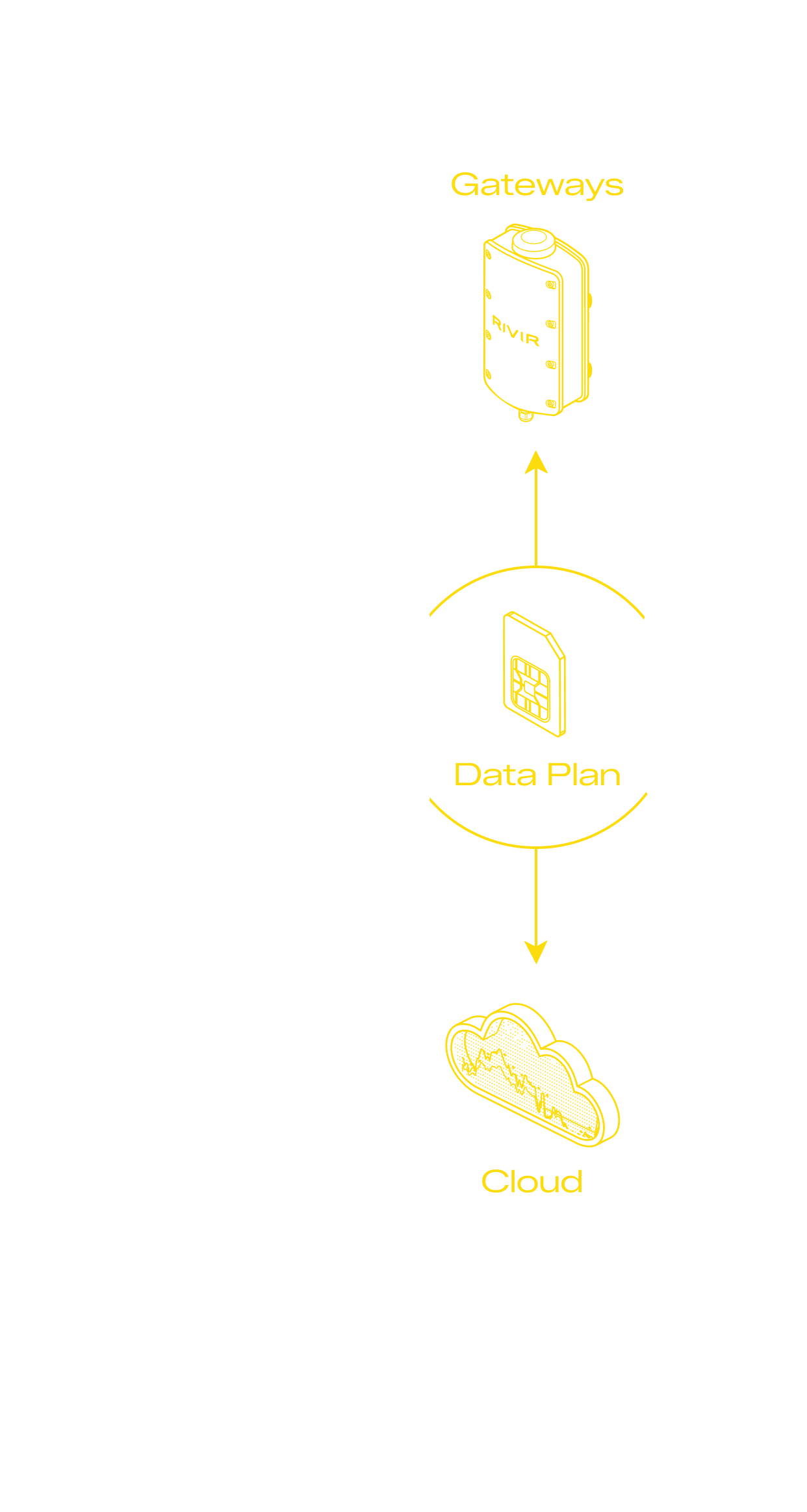
Your Assets
Starlink Satellites
Your Systems
RIVIR Gateways
RIVIR Data Plan
RIVIR Platform
Are you ready for IoT using Starlink D2C?
With 650+ satellites and global coverage, Starlink D2C is changing how the world communicates. For the first time, industrial IoT devices can connect to satellites using standard cellular technology with the RIVIR System.
Remote connectivity that was once impossible, expensive and unreliable is becoming accessible. Companies that seize the opportunities of this satellite shift will define how the industry connects for decades to come.

Frequently asked questions
What does RIVIR do?
RIVIR provides an advanced IoT gateway system that combines terrestrial cellular with Starlink's Direct to Cellular satellite network. This provides a reliable way to connect remote, mobile, and critical assets anywhere and at all times. In locations with no cell coverage or during network outages, RIVIR's hybrid approach keeps your data flowing so you never lose visibility of the assets that matter most.
What makes the RIVIR Gateway different from traditional MQTT-based IoT gateways?
RIVIR Gateways are the first in the world that are built to seamlessly blend existing terrestrial cellular networks with Starlink's new Direct to Cellular (D2C) network to offer uninterrupted connectivity across a whole country and during events that disrupt terrestrial cell networks.
The core difference between the RIVIR Gateway and existing IoT gateways, which allows this seamless roaming from terrestrial connectivity to satellite, is the protocol that the RIVIR system uses to send data over the low bandwidth, intermittent and latent satellite network.
Most older IoT gateways use the MQTT over TCP IP protocol, which requires a continuous and very "chatty" TCP IP session running between the gateway at the edge and the customer's central business systems in the cloud. Maintaining that chatty underlying "call" is a real problem when you're trying to communicate through LEO satellites that are orbting 350 miles up, at 17,000 miles per hour and only available for short connectivity windows.
The RIVIR System uses a UDP based "vitually persistent digital twin" protocol instead, which is a sessionless system that doesn't need that constant IP connection. It's up to 88% more data efficient than MQTT over TCP IP, for the same task. It draws 33% less power and it protects the capacity of the network for other users. In practical terms, it means your data is far more likely to get through the satellite nework reliably, especially when the network is under pressure.
Can the RIVIR System work in areas with no cellular coverage at all?
Yes, that's exactly the problem RIVIR System was built to solve. When a cellular tower is available, the gateway uses it because it's cheaper and faster, but the RIVIR system also seamlessly switches to satellite connectivity when cell service drops out. This hybrid approach means you get the best of both worlds; coverage everywhere with the added benefit that your monitoring stays online even during emergencies or natural disasters that knock out ground-based networks.
Why does the RIVIR System use a special protocol for satellite IoT?
The RIVIR System uses an open standard protocol for running scalable IoT applications over constrained networks. This protocol is ideal as it can handle the exact latency, bandwidth and intermittency challenges that LEO satellite networks present for IoT and M2M communications.
The protocol uses a firmware client on the gateway paired with cloud-based server software to maintain secure, continuous virtual two-way communication sessions that survive network interruptions.
This protocol also doubles as a device management protocol, which makes it much easier to deploy and manage a large fleet of IoT-enabled assets remotely without needing to visit each one.
Is the RIVIR System proven technology, or is it still in development?
RIVIR has a track record of satellite enabled IoT success behind it. The company's earlier 100 series gateway was successfully deployed across multiple industries and countries to connect industrial assets over the SpaceX Swarm LEO network.
The current R200 series builds on that experience and is purpose-built for the next generation of Starlink Direct to Cellular satellite networks. The system was developed under NDA with SpaceX, and RIVIR was the first company to transmit IoT LTE data over the satellite network in New Zealand and Canada.
Demo units are available now for organisations that want to test the technology in their own environment before committing.
How does the RIVIR System integrate with existing business systems and sensors?
Integration of the RIVIR System is designed to be very straightforward with both your edge asset and with your central business systems.
At the asset level, RIVIR Gateways can be easily connected to most sensors, PLCs, and other smart equipment through wired or wireless connections using a wide range of edge protocols including Modbus, CANBus, OBD2, J1939, NMEA 2000, LoRA and more. RIVIR gateways can be integrated with any modern industrial data protocol.
In the cloud, the RIVIR System provides REST APIs that allow remote IoT data to flow directly into your centralised business systems, whether that's a SCADA platform, asset management software, or a custom data environment. The RIVIR Cloud can also support other data integrations as required.
RIVIR's engineering team also offers hands-on integration services for both hardware and API connections, so you're not left figuring it out on your own if your setup has specific requirements.
What happens to my data if the satellite isn't overhead when the RIVIR System tries to send it?
The RIVIR System handles this by using a virtually persistent digital twin protocol, similar in logic to text messaging - rather than making a phone call. Instead of needing a live, continuous link to transmit data, the RIVIR System's internal protocol queues data and manages secure communication sessions that pick up exactly where they left off when the next satellite pass occurs.
Your data doesn't get lost during gaps in coverage, it just waits and gets delivered reliably on the next available pass, with the system maintaining full integrity of the two-way session throughout.
Do I need to replace my existing sensors and equipment to use the RIVIR System?
No, the RIVIR Gateways are designed to sit alongside your existing infrastructure and connect to the sensors, PLCs, and smart assets you're already using.
The RIVIR System interfaces through standard industrial protocols like Modbus, CANBus and LoRA, which are widely supported across most industrial sensor and equipment manufacturers.
Rather than replacing anything, you're essentially adding a satellite communication layer on top of what's already in place. This keeps the disruption of deployment much lower than most people expect.
What kind of data can the RIVIR System actually collect and transmit from remote assets?
The RIVIR System can integrate with virtually any edge smart asset or sensor and transmit it's data over satellite to your business systems.
The data you can collect depends on what sensors and equipment you connect to the gateway, not on any limitation of the RIVIR System itself. It can relay whatever your connected devices are measuring.
In practice, that includes things like engine hours, flow rates, pressures, oil levels, temperatures, dissolved gas levels, voltage readings, methane concentrations, tank levels, equipment status indicators, lubrication data, and weather metrics.